A conch piercing is the kind of piercing that instantly elevates your ear stack. The jewelry is inserted through the cartilage in the center of your ear, and you can go in any direction with the look: from a small, subtle stud to a statement ring.
Sounds good, but before you book that appointment, you’ll probably want to know what you’re getting into. How much does a conch piercing actually hurt? How long does it take to heal? Can you sleep with it in? And when can you finally switch to that first different piece of jewelry?
From pain and aftercare to sleeping, swimming, and choosing between a ring or a stud: here’s everything you need to know before getting a conch piercing.

What is a conch piercing?
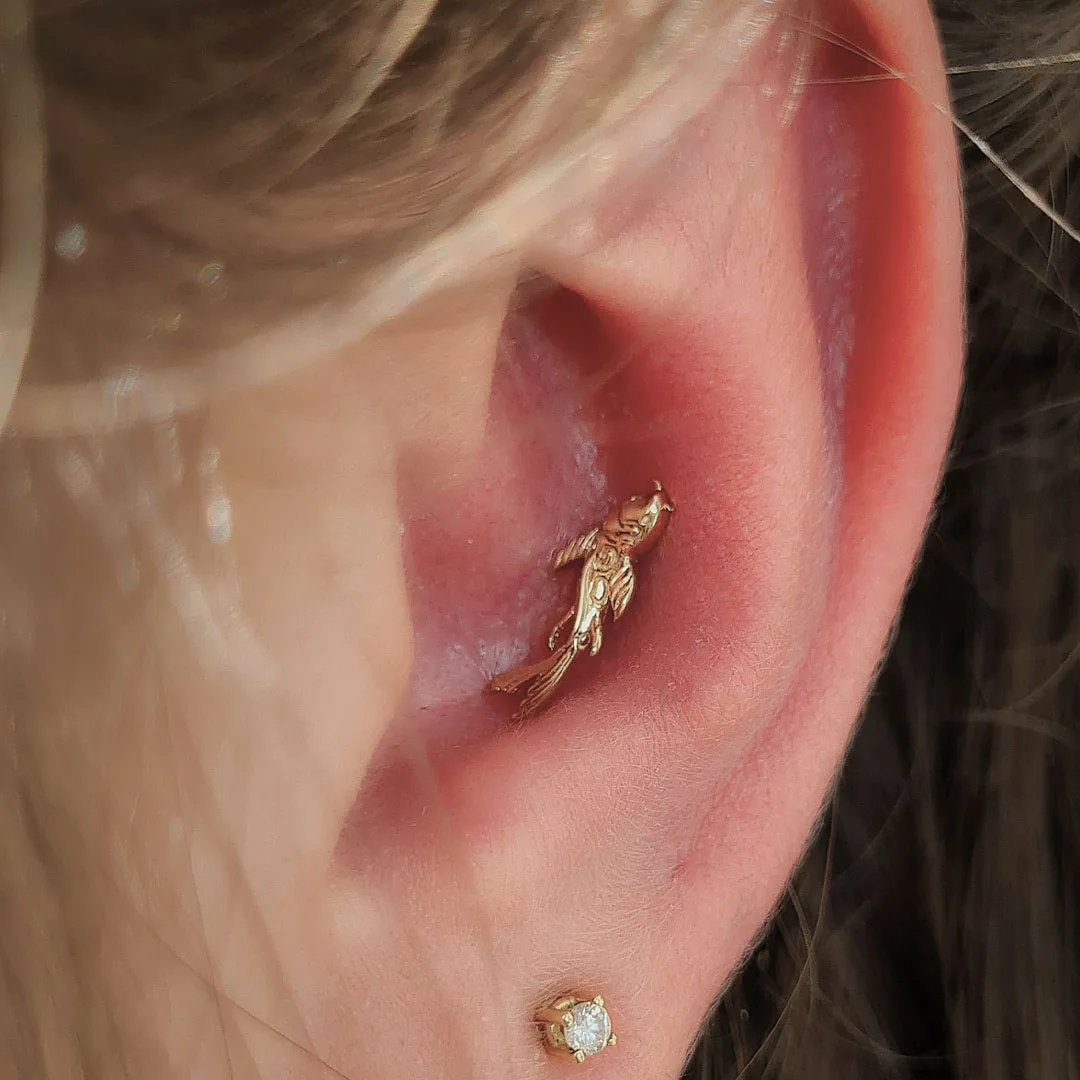
The conch is the firm piece of cartilage in the center of your ear, named for its shell-like shape. A conch piercing is placed right through this part of your ear. And although the spot may seem small, there are quite a few jewelry options to choose from.
There are two types: the inner conch and the outer conch. With an inner conch piercing, the jewelry is placed slightly closer to the center of the ear, while an outer conch piercing is located higher up and closer to the outer edge.
Which style suits you best isn’t just a matter of taste. Every ear is different, and your anatomy ultimately determines where a conch piercing can be placed safely and attractively. That’s why a professional piercer will first take a close look at your ear before even picking up the needle.
Does a conch piercing hurt?
Let’s answer right away the question that’s probably at the top of your list: yes, you can feel a conch piercing. After all, it’s cartilage, not an earlobe. But before you scare yourself off: the piercing itself only takes a few seconds.
You’ll mainly feel a sharp pressure when the needle goes through the cartilage. How intense that feels varies from person to person. For some, it’s over in the blink of an eye, while others find it a little more nerve-wracking.
That’s exactly why it’s important to have your conch pierced by a professional piercer. At INKORPORATED, we take the time to examine your ear, your anatomy, and your preferences before we begin. Proper placement not only determines how your piercing looks, but also how comfortably it heals.
After the piercing, your ear may still feel a little sensitive, warm, or slightly swollen for a while. That’s completely normal. So be sure to let your piercing heal and follow the aftercare instructions provided by your piercer.
Are you feeling a little nervous? That’s completely understandable. Feel free to stop by one of INKORPORATED’s boutiques. Our piercers will take the time to answer your questions, help you decide, and explain what to expect. That way, you’ll know exactly what to expect before you decide to get your piercing.
How long does it take for a conch piercing to heal?
A conch piercing requires a little more patience than a piercing through your earlobe. After all, you’re having a hole pierced through cartilage, and that simply takes a little longer to heal completely.
On average, expect it to take 6 to 12 months to heal completely. Don’t panic: that doesn’t mean your ear will be sensitive or painful for a whole year. The first few weeks and months are especially important for giving your piercing the rest and care it needs.
And here’s the tricky part: a piercing can look completely fine on the outside, even while the tissue on the inside is still healing. So be patient—even if, after a few weeks, you’re already wondering which ring you want to put in it.
So don’t change your jewelry too soon. Your piercer can determine when your conch has healed enough to safely change the jewelry or when the initial jewelry needs to be adjusted.
How do you care for a new conch piercing?
Of course, a beautiful conch piercing starts with the placement, but after that, it’s mainly a matter of taking good care of it and not fiddling with it too much. Your piercing needs time to heal properly, and there’s a lot you can do to help with that.
Always wash your hands thoroughly before touching your piercing. Clean your piercing according to the aftercare instructions provided by your piercer, and otherwise leave the jewelry alone as much as possible. So don’t twist it, move it back and forth, or keep touching it just because you’re curious about how it’s healing.
Also be mindful of anything that might come into contact with your ear. Headphones, a helmet, a phone, your hair, or even your pillow can cause quite a bit of pressure and friction without you even noticing. You’ll want to avoid this as much as possible, especially in the early stages.
Can you sleep with a new conch piercing?
And then sleep. If you usually sleep on your side, a new conch piercing can be a bit of a challenge at first. Try not to lie on the side of your piercing for the first little while. Prolonged pressure can cause irritation and, in some cases, even affect the placement of your piercing.
At INKORPORATED, you’ll receive clear aftercare instructions tailored to your piercing after your appointment. Do you have any questions during the healing process, or are you unsure about something? Feel free to contact us. It’s better to ask one question too many than to experiment on your own with your new piercing.

When can you change a conch piercing?
We get it: as soon as your conch looks good, you’ll probably want to move right on to the next look. Still, this is one of those times when you need to be patient. A piercing may already look healed on the outside, while the cartilage on the inside is still in the midst of healing.
Therefore, wait to change your jewelry until your piercer tells you that your conch is ready. On average, it takes 6 to 12 months to heal completely.
That’s exactly why it’s a good idea to choose a piece of jewelry you’re truly happy with right from the start. At INKORPORATED, we have a carefully curated collection of high-quality piercing jewelry, ranging from minimalist studs to eye-catching designs. So choose something right away that you’ll enjoy wearing for a while, and then be sure to give your new piercing the rest it needs.
Once your conch has fully healed, are you ready for something new? Then it’s time to go shopping. Check out our collection of high-quality piercing jewelry in our online store and give your ear stack a new look.
A conch ring or a stud?
You can make a conch piercing as eye-catching or as subtle as you like. The biggest choice? Are you going for a stud or a ring?
A delicate stud gives your ear stack a clean, minimalist look. A hoop draws a little more attention and instantly gives your ear a slightly edgier look. Which of the two suits you best is, of course, a matter of taste—but with a new conch piercing, there’s another factor to consider.
A ring moves around more and can therefore cause friction and irritation more quickly. That’s why the conch is often pierced with a stud first. Once the piercing has fully healed, you can switch to a ring if you’d like.
And then there’s the material. Beauty is one thing, but when it comes to piercings, you want to wear something that’s right for your body. At INKORPORATED, you’ll find high-quality jewelry made from materials such as implant-grade titanium and solid gold, carefully selected for your piercing.
Can you swim with a conch piercing?
A new piercing and a dip in the pool aren’t exactly the best combination. As tempting as it may be to jump right into the water with your new conch piercing, it’s best to hold off on swimming for a while during the initial healing phase.
Swimming pools, the ocean, lakes, and other public bodies of water may contain bacteria that can irritate a fresh piercing. And let’s be honest: a few weeks without swimming is a lot better than months of dealing with an irritated piercing.
Are you going on vacation or planning a day at the beach? Keep that in mind when you get your piercing. Not sure about swimming or other activities while it’s healing? Feel free to ask your piercer.

What if your conch piercing gets irritated?
A little redness, tenderness, or swelling is often just part of the healing process for a new piercing. A small bump may also develop during healing if, for example, your piercing gets caught on something or is subjected to too much pressure.
Most importantly: don’t panic, and above all, don’t try to treat it yourself. So don’t pick at the bump, twist your jewelry endlessly, or smear all kinds of bathroom remedies on it. Cleaning it too much can actually irritate your piercing even more.
Is your conch still sore, is the swelling getting worse, or do you just feel uneasy about it? Then have a professional take a look at it. At INKORPORATED, you’re always welcome to stop by with questions about your piercing. Our piercers will examine it with you and can advise you on the best next step.
Is a conch piercing suitable for every ear?
Short answer: Not every ear is the same, and that’s actually a good thing. A conch piercing can be placed slightly differently on one person than on another, depending on the shape and anatomy of your ear.
Your piercer will consider, among other things, the thickness of the cartilage, how much space there is, and how the jewelry will ultimately sit. This isn’t just about the look—it’s also to ensure that your piercing heals as comfortably as possible.
Not quite sure which piercing is right for you? Check out our guide on which piercings suit your ears, or just stop by INKORPORATED in Amsterdam. We’ll answer your questions, brainstorm with you, and help you choose the piercing that’s truly right for you.
Why choose a conch piercing?
A conch piercing is versatile, relatively subtle, and yet striking enough to make your ear stack just a little more interesting.
You can keep it small and minimalist with a delicate stud, or choose a ring that draws more attention later on. You can also pair it nicely with other ear piercings, such as a helix, flat, or tragus.
It’s exactly that combination that makes the conch so fun: you can customize it completely to suit your style.
Getting a conch piercing in Amsterdam
After reading this, are you already wondering which side of your ear that conch should go on? Then maybe it’s time to just have it checked out.
At INKORPORATED, our professional piercers first take the time to examine your ear and anatomy and work with you to determine the right placement and jewelry. Because a beautiful piercing doesn’t start with the needle—it starts with proper preparation.
Ready for your conch? Then we’ll see you at the studio.